blueguard.us
From Blue to Pure

“With just one drop of Prussian blue pigment, we eliminate the invisible threat of plastics in your water.”

After: 100% nanoplastics removed, leaving only pure, fresh water.
The Problem:
A Growing Invisible Threat
Plastic pollution has become a critical and invisible crisis, invading ecosystems, food chains, and our bodies. Humans ingest approximately 5 grams of plastic weekly—the weight of a credit card—through water, food, and air. Bottled water, often considered safe, contains up to 240,000 plastic particles per liter, mostly nanoplastics—tiny fragments less than one micrometer in size. Disturbingly, nanoplastics have even been found in human breast milk, exposing infants during their most vulnerable stages.
Nanoplastics are particularly dangerous, bypassing traditional filtration systems and entering the bloodstream, liver, and brain, where they silently accumulate and disrupt vital functions. The water bottle you’re holding right now could already be contributing to this hidden threat.
Prevention is critical. Nanoplastics pose not just individual health risks but a ticking time bomb for global health. Left unaddressed, they could lead to new diseases and become a daily hazard. BlueGuard is here to act now, stopping nanoplastics before they become an unavoidable disaster. Prevention isn’t optional—it’s the solution.
Sources
Berger, Stephanie. “Bottled Water Can Contain Hundreds of Thousands of Nanoplastics.” Columbia University Mailman School of Public Health, 9 Jan. 2024, www.publichealth.columbia.edu/news/bottled-water-can-contain-hundreds-thousands-nanoplastics.
“Bottled Water Volume in the U.S., 2017 | Statistic.” Statista, Statista, 2017, www.statista.com/statistics/237832/volume-of-bottled-water-in-the-us/.
BrainTree Biotechnology Institute. “Do Bottled Water and Beverages Contain Microplastics?” YouTube, 31 Oct. 2022, youtu.be/DVsYRwXBxl0?si=R1QtuWd_qCsIFfAt. Accessed 30 Dec. 2024.
GLOOM, and GLOOM. “Microplastics & Nanoplastics Cross Blood-Brain Barrier within Hours & May Cause Damage.” MentalHealthDaily, 22 Nov. 2023, mentalhealthdaily.com/2023/11/22/microplastics-nanoplastics-cross-blood-brain-barrier-within-hours-may-cause-damage/. Accessed 10 Jan. 2025.
Kopatz, Verena, et al. “Micro- and Nanoplastics Breach the Blood–Brain Barrier (BBB): Biomolecular Corona’s Role Revealed.” Nanomaterials, vol. 13, no. 8, MDPI, Apr. 2023, pp. 1404–4, https://doi.org/10.3390/nano13081404.
“Nanoplastics and ‘Forever Chemicals’ Disrupt Molecular Structures, Functionality.” ScienceDaily, 2024, www.sciencedaily.com/releases/2024/07/240711132144.htm. Accessed 30 Dec. 2024.
Osaka, Shannon. “Here’s What You’re Really Swallowing When You Drink Bottled Water.” Washington Post, 9 Jan. 2024, www.washingtonpost.com/climate-environment/2024/01/08/microplastics-nanoplastics-bottled-water-study/.
Qian, Naixin, et al. “Rapid Single-Particle Chemical Imaging of Nanoplastics by SRS Microscopy.” Proceedings of the National Academy of Sciences of the United States of America, vol. 121, no. 3, Jan. 2024, p. e2300582121, https://doi.org/10.1073/pnas.2300582121.
“Revealed: Plastic Ingestion by People Could Be Equating to a Credit Card a Week – WWF-Australia | Revealed: Plastic Ingestion by People Could Be Equating to a Credit Card a Week | WWF Australia.” Wwf.org.au, 12 June 2019, wwf.org.au/news/2019/revealed-plastic-ingestion-by-people-could-be-equating-to-a-credit-card-a-week/.
Why BlueGuard?
Currently, no water purification system on the market effectively eliminates nanoplastics, as seen in bottled water from leading brands. BlueGuard provides a simple and groundbreaking solution, using the natural properties of Prussian blue pigment to eliminate nanoplastics effectively and sustainably.

How BlueGuard’s Water Filtration System Works
Step-by-Step to Clean Water
- Add Water and Solution:
Fill the upper chamber with tap water and add 10ml of Prussian blue pigment solution.
2. Wait for Activation:
Let it sit for 15 minutes under visible light to allow the solution to cluster nanoplastics.
3. Start Filtration:
Open the ball regulator to let water flow through the filter paper, which removes the clustered nanoplastics and any remaining pigment particles.
4. Collect Pure Water:
Pure water drips into the lower chamber, ready to drink. Use the vacuum pump for faster filtration.

Why it works?
The Science Behind BlueGuard
1. When added to water, Prussian blue pigment disperses into microscopic particles. These particles act like magnets, binding to nanoplastics.
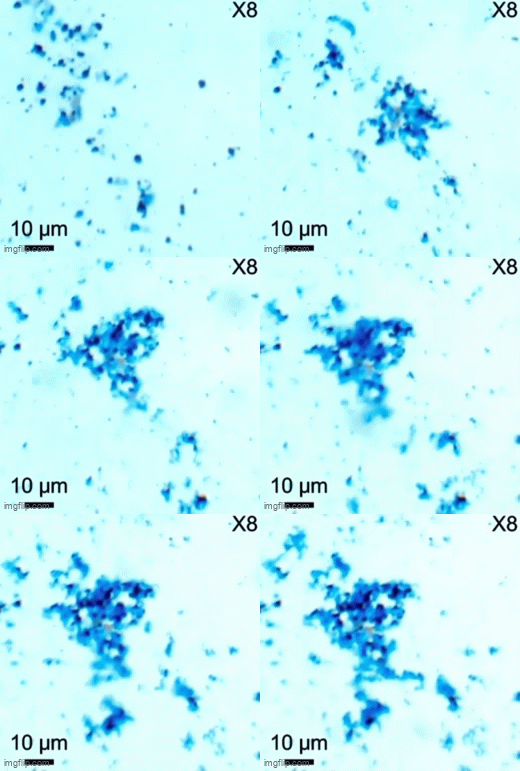
2. Under visible light, the Prussian blue activates, clustering the nanoplastics into larger particles that can no longer remain suspended in water.
3. As water flows through the filter, the clustered nanoplastics and pigment particles are trapped, leaving only purified water.
4. The final result is clean, nanoplastic-free water collected in the lower chamber, ready to drink.
Intended Impact of BlueGuard
Every bottle of water we drink may contain hundreds of thousands of nanoplastics, infiltrating the body and accumulating in vital organs. With 8.2 billion people relying on water daily, this invisible crisis demands urgent action. BlueGuard eliminates these hidden contaminants at the source, preventing long-term health risks while promoting sustainability. If widely adopted, it could remove trillions of nanoplastics annually, transforming water safety on a global scale. Plus, by repurposing filtered Prussian blue pigment into eco-friendly paints and crayons, BlueGuard turns waste into innovation, ensuring a cleaner planet.

An array of resources

BlueGuard isn’t just a water filter—it’s a revolution in purification. Using a non-toxic, energy-efficient process, it removes what other systems can’t. Scalable for homes, businesses, and industries, it sets a new standard for clean drinking water. Protect future generations, and eliminate plastic from your water with BlueGuard.



Meet our team

Nora Ni
Experienced in digital media and marketing, Nora developed the original prototype for our innovation. As a multiple-time math contest winner, she combines analytical thinking with creativity, overseeing the innovation brief, marketing strategies, and sales initiatives.

Grace Wang
With strong leadership and organizational skills honed through managing a nonprofit, Grace brings expertise in website design, 3D modeling, and financial management. Her dedication ensures seamless project coordination and strategic oversight.

Noah Gama
A creative problem-solver and president of the school science club, Noah has experience in water-powered machines and leads the development of our video, physical model, and functionality testing. He also spearheads manufacturing efforts, ensuring precision and quality.
FAQs
Is Prussian blue harmful? Is it safe?
Prussian blue is completely non-toxic and safe for water purification. It is even recognized by the World Health Organization as an essential medicine for treating certain radioactive exposures. In BlueGuard’s system, it effectively removes nanoplastics without introducing any harmful chemicals, making it a safe and eco-friendly solution.
What is Prussian blue pigment, and what are its properties?
Prussian blue is a synthetic pigment known for its unique ability to bind with contaminants, including nanoplastics. Its molecular structure enables it to cluster tiny particles into larger ones for easy removal. Beyond water purification, it has been recognized for its role in addressing radioactive exposures, showcasing its versatility and safety.
What happens to the nanoplastics after filtration?
After filtration, the Prussian blue pigment, along with the trapped nanoplastics, remains on the filter paper. Once removed, the pigment can be repurposed immediately as blue paint, eliminating waste and promoting sustainability. This upcycling process transforms what was once contamination into a valuable and creative material.
